Select your language


02.21.39.247 Contact us


Electric Heating Consumption: Is It Really Worth It? Let’s Clarify
How much does an electric heating system consume?
Consumption is not a fixed value: it mainly depends on the building envelope, meaning the level of thermal insulation. Heating a 1970s home with single-glazed windows will require twice the energy compared to a modern or renovated property using advanced materials and technologies. Improving the building’s energy efficiency class is therefore essential to reduce consumption.
That said, the real advantage of electric heating lies in its modularity. Unlike centralized gas systems that often heat the entire home unnecessarily, electric heating allows you to create independent zones. The secret to saving energy is adapting heat to the specific needs of each room: heating only where needed, as much as needed, and only when needed.
How much does it cost to heat a home with electricity?
The final cost largely depends on how the system is designed. A common mistake is incorrect sizing: installing a unit that is too small for the room forces it to operate constantly at full power, increasing costs and reducing comfort.
How many kW (or Watts) are needed to heat a 20 sqm room?
To answer correctly, you must consider ceiling height, geographic location, and insulation level. As a general rule, it is always better to choose a slightly oversized product rather than an undersized one. A more powerful radiator reaches the set temperature faster and then modulates power once comfort is achieved, resulting in lower long-term consumption. (On our website you can find a useful GUIDE to calculate your room’s heating requirements).
How many kW are required to heat a 100–150 sqm home?
The fear of “tripping the meter” is common. However, thanks to zone management, not all radiators operate at the same time. By scheduling the living area in the morning and the sleeping area in the evening, the instantaneous power demand will be far lower than the total installed radiator capacity.
How much does an electric radiator consume?
This is where technology makes the difference. Modern digital radiators do not operate in simple ON/OFF mode (fully on or completely off), but use automatic power self-regulation systems.
How much does a 2000 Watt electric radiator consume?
Many people think a 2000W radiator consumes 2 kWh for every hour it is on. FALSE. This power is absorbed only during the initial phase to bring a cold room up to temperature. Once comfort is reached, the smart thermostat drastically reduces consumption, using only the energy required to compensate for heat loss — often just a few hundred Wh when thermal dispersion is limited.
How much does electric heating consume per hour?
It depends on thermostat accuracy. Modern electronic thermostats feature sensors capable of detecting temperature variations of just a few tenths of a degree. This keeps the temperature stable without fluctuations, ensuring a much lower average hourly consumption compared to the product’s nominal power. Constant manual adjustments — which are disastrous for energy consumption — are no longer necessary.
Is gas heating or electric heating more expensive?
If you compare the pure unit cost of energy (Gas vs Electricity), gas may appear cheaper. However, to evaluate real cost-effectiveness, overall efficiency must be considered:
- Efficiency: electric heating offers 100% efficiency (all electricity is converted into heat), while boilers suffer from energy losses.
- Investment and fixed costs: electric systems have virtually zero maintenance costs, require no periodic inspections, flue checks, or complex piping installations.
- Renewable energy: when combined with a photovoltaic system with storage, electric heating becomes unbeatable in terms of operating costs.
Which type of electric heating consumes the least?
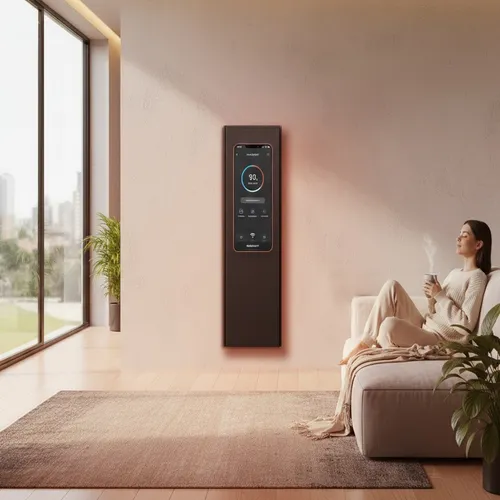
To save energy, you should avoid cheap space heaters or old mechanical convectors. The most efficient systems are those with thermal inertia or dual heating technology (radiant + convection), supported by advanced electronic controls.
What are the best low-consumption electric radiators?
The most efficient devices on the market are those equipped with smart energy-saving features, such as those found in the Radialight Wall-Mounted Electric Radiators range:
- Open Window Detection: the radiator automatically switches off when a sudden temperature drop is detected.
- Presence Sensor: heating output is automatically reduced when the room is empty.
- Weekly Programming: setting different temperatures for different time slots is the key to saving energy.
- ECO Mode: maintaining a reduced temperature (for example 3.5°C lower than comfort level) when the room is not in use reduces consumption by 7% for each degree lowered.
Energy consumption monitoring and connectivity
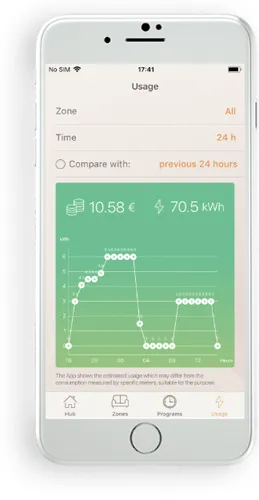
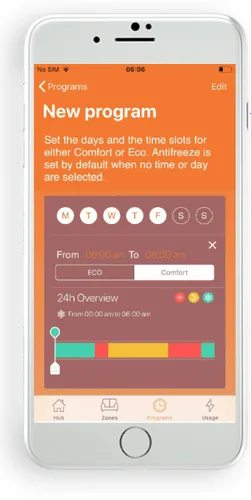
Monitoring energy consumption for conscious use
Knowing exactly how much your electric heating system consumes in real time is extremely valuable information. The latest-generation radiators, such as the Radialight Wi-Fi models, allow you to view precise energy consumption data in kWh (daily, weekly, monthly) via an App. Full control of your system — even remotely — allows you to quickly eliminate waste, save time, optimize costs, and achieve maximum comfort with minimum energy consumption.